

Department of Drug Discovery & Biomedical Sciences
Explore how basic science and research uncover mechanisms of disease and advance new therapeutic discoveries.
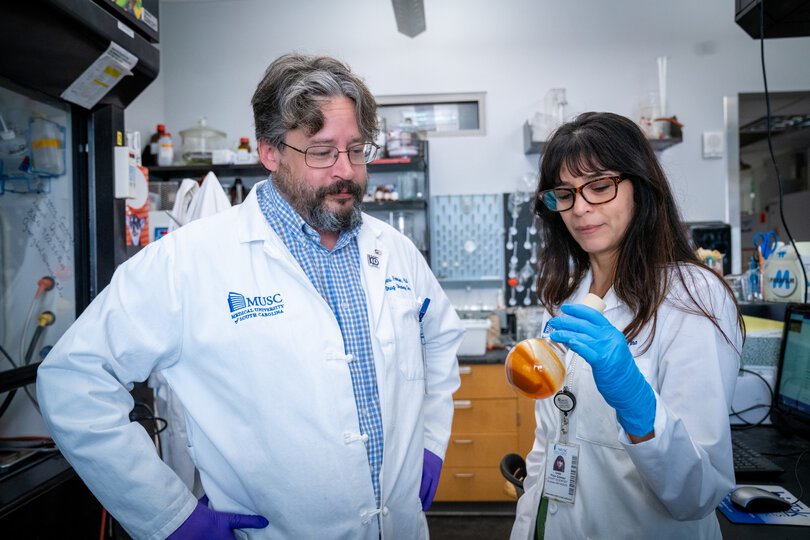
The Department of Drug Discovery and Biomedical Sciences (DDBS) provides training in the basic sciences to professional (Pharm.D.) and graduate students (Ph.D.). Training provides fundamentals in the health sciences including; biochemistry, cell and molecular biology, pharmacology, oncology, and neuroscience. Research training in DDBS encompasses the understanding of disease mechanisms, drug action, and toxicity, the design and development of new pharmaceutical agents, and the identification of new drug targets. Graduates of the program (Pharm.D./Ph.D. or Ph.D.) can pursue multiple exciting career opportunities in academia, pharmaceutical, and biotechnology companies, or with government agencies. DDBS has 11 faculty members.
Research efforts in DDBS include the following areas: chemical biology/medicinal chemistry, translational cancer therapeutics, mitochondrial biology, cell death, injury and regeneration, pharmacogenomics, targeted therapeutics, pharmacology, neuroscience, and personalized medicine.
- Graduate Program
- Research Centers and Initiatives
- Endowed Chairs
- Faculty Research Labs
- DDBS Recent Publications
- Faculty Directory
Research & Scholarship
Research Centers
Center for Cell Death, Injury, & Regeneration
The Center for Cell Death, Injury, & Regeneration was established in 2007 and is headed by John J. Lemasters. The center provides imaging facility through the use of six confocal and multiphoton microscopes which are also a part of the Hollings Cell and Molecular Imaging Facility. The center also is home to a multiwell plate reader and Seahorse Bioscience facility. Anna-Liisa Nieminen is co-director of the imaging facility. In addition the center also houses imaging workstations, surgery benches, and tissue culture hoods for specimen preparation and data analysis.Center for Cancer Drug Discovery & Drug Discovery Core
The Center for Cancer Drug Discovery provides mechanisms for target identification and generation of lead compounds in the drug discovery process, thus creating a productive interface between academics and the biotechnology/pharmaceutical industries. The center and the MUSC Drug Discovery Core are headed by Yuri Peterson.Medication Therapy Management Center
The college launched the Medication Therapy Management Center as part of its move to a new facility in the heart of the Medical University of South Carolina campus. The new space offered an ideal area for an MTM Center with many benefits.
Endowed Chairs & Professorships
GlaxoSmithKline SmartState Endowed Chair in Advanced Cellular Technology
John J. Lemasters, M.D., Ph.D., is a pioneer of techniques that allow scientists to see what happens inside an individual cell during reoxygenation - the restoration of oxygen to an organ following oxygen deprivation, which sometimes occurs following a heart attack or stroke. The process of redistributing oxygen to an organ can be stressful on tissue, leading to possible trauma, and even cell death. Dr. Lemasters specializes in a kind of microscopy that allows scientists to view slices of an individual cell, much like CAT or MRI scans complement the more traditional X-ray by allowing doctors to view the body in layers. Other applications for his work include understanding the mechanisms through which the liver is injured by chronic alcohol use and donated organs are damaged while being held for transplant surgery. He serves as the director of the Center for Cell Death, Injury, and Regeneration. The Center for Cell Death, Injury, and Regeneration was established in 2006 and provides imaging facility through the use of five confocal microscopes which are also a part of the Hollings Cell and Molecular Imaging Facility. The center also is home to a multiwell plate reader. Ongoing projects in the center’s laboratory using the microscopes include Intravital Imaging of Liver Function using Multiphoton Microscopy, Autophagy/Mitophagy, Mitochondrial Permeability Transition (MPT) and Luminescence Lifetime Imaging Microscopy.
South Carolina SmartState Endowed Chair in Drug Discovery
The South Carolina SmartState Endowed Chair in Drug Discovery is a distinguished academic position dedicated to advancing innovative research in medicinal chemistry and therapeutic development. This endowed chair leads collaborative efforts to discover and develop new drugs that improve human health and strengthen South Carolina’s biomedical research enterprise. The position is currently open, and the university is seeking an exceptional scientist to continue this vital work.
Vincent T. Peng, M.D., Endowed Professorship in Medicinal Chemistry
The Vincent T. Peng, M.D., Professorship in Medicinal Chemistry supports distinguished faculty whose teaching and research advance the field of medicinal chemistry. The professorship is currently open, and the search is underway for the next leader to continue this tradition of excellence.